These ten images, taken throughout the semester, represent a theme I found I focused on often: texture.
4.22.2010
Final Project and Semester Summation
I began writing a scientific case study and I ended with an emotive and introspective series of narratives.
My first sentence, "51 year old female presenting with non-fluent aphasia, telegraphic speech, apraxia, and mild hemiplegia impeding dexterity to right hand consistent with left anterior frontal cortex damage," made me think what my client would say. K.J. would look at me, wait until I finished, and would say, "so? I don't care."
I began with a personal introduction detailing experiences that have shaken my faith and drastically altered my outlook in respect to the health care field, a profession which I so transparently idolize. A few weeks after the start of my semester, in an EMT course, I witnessed horrifying events in the hospital.
My first sentence, "51 year old female presenting with non-fluent aphasia, telegraphic speech, apraxia, and mild hemiplegia impeding dexterity to right hand consistent with left anterior frontal cortex damage," made me think what my client would say. K.J. would look at me, wait until I finished, and would say, "so? I don't care."
K.J. Learning how to master her camera--it didn't take long
I began with a personal introduction detailing experiences that have shaken my faith and drastically altered my outlook in respect to the health care field, a profession which I so transparently idolize. A few weeks after the start of my semester, in an EMT course, I witnessed horrifying events in the hospital.
"Within ten minutes of the start of my first shift in Winter Park Memorial Hospital, paramedics rushed in an unresponsive John Doe, a male in his late 40’s or early 50’s. He was found less than a block away from the ER, a concrete divider stopped his car, still in drive. He was gurgling and a terrifying shade of purple. I grabbed a respirator and began ventilating the man while the trauma room became a warzone, with the doctor shouting orders and nurses coordinating the scene. Initially, I was excited to see such a “cool” case, and surprised by the essential responsibility of ensuring a patent airway and deliver oxygen, assist in cardiopulmonary respiration, and the delivery of basic salts to reduce the patient’s acidosis. At the time, high on the adrenaline of a true emergency, I had no idea how affecting this night would become."
"Everyone in the room knew the damage had been done and was irreversible. As I manually breathed the patient on the trip back to the ER trauma room, I realized this was my first true encounter with death.
The patient was no longer John Doe, but a 52-year-old father, a husband, a son, and a beloved music teacher. The room was crowded with his family, obviously in shock. While I waited for a technician to hook the patient back up to an automatic respirator, I squeezed the ventilation bag every six seconds. I watched as the doctor walked into the room, nonchalantly informed the family that the patient suffered a massive brain hemorrhage and that there was absolutely nothing he could do.""I checked up on the family every quarter hour and explained to them anything I could. What scared me the most, much more than the fragility of life, the suddenness, the arbitrariness, the permanence, the absence of hope and dignity, was that I seemed to be the only one who cared."
Still, I had set out to write a case-study, and rationalized that it too would be personal.
"Clinical work in neuropsychology differs greatly from the trend of impersonality and façades of objectivism the scientific community so fervently defends. All other organs in the body can be reduced to specific anatomies, physiologies, and biochemistries, yet the brain transcends even the most astute reductionist techniques. Case studies, detailed and personal accounts of patients, have little choice but to include emotional developments between a clinician and patient. While I understand the need for double-blind pharmacologic studies, assessing individual therapies on a patient-to-patient basis gives neuropsychology an entirely different aesthetic from other descriptive sciences. Each brain is as idiosyncratic as the individual it represents, and, in tragic circumstances of injury, each presentation of signs, symptoms, and compensation techniques is unique."
I grappled with the pretentious jargon and insensitivity. I wanted to explore what I had actually learned and give credit the relationships that I had formed.
"I believe my experience in the Photography as Language course has truly bolstered my ideals of a patient- or client-centered approach to treatment. K.J. is extraordinarily intelligent, focused, and determined. She requires a personalized therapy plan and individual attention because, frankly, she is easily bored. She expressed resentment at the “stupid” generic formal testing, but her independent drive for recovery and self-betterment extends her patience. Two times a week, K.J. navigates the city of Orlando on the public transportation system (not a simple task) and is punctual and energetic.
I was lucky enough to develop more than a superficial relationship with this phenomenal woman. I absolutely loved her mannerisms and personality quirks. K.J. was never once quiet with her praise or criticism, unabashedly walking to the board to point out an element she liked or responding to another client’s photographic grouping as “stupid.” She pushed me to think creatively and work especially hard (her criticism could easily take a turn and target me), yet still provided endless entertainment, astounding photographs, and insight into her life—past, present, and future."
"That first fateful day, we had to select one of our printed photographs to show to our new client to jumpstart the speech therapy. I chose a bland image of a person, beach, and birds. Inspired by a paper I had just read for my neuropsychology class outlining the double disassociation of noun/verb duality, I attempted to be an amateur neuropsychologist. I felt the image provided a story and a plethora of descriptive words to review for an aphasic patient: sand, clouds/cloudy, birds, flight/flying, running, beach, smile/smiling, and various other nouns, verbs, and adverbs. Patients often have trouble with either words related to imagery or trouble with more nebulous concepts. It's easier to imagine a bird in your head, but the imagery of "flying" requires one to create a mental scenario with an object to partake in flight[1].
Of course, I got what was coming for me. K.J. is extremely feisty, extraordinarily smart and quick-witted. Well, she took one look at my picture, frowned, said “ew,” and pointed and smiled to Diego's photograph of beautifully composed and vibrant marker heads, creating a rainbow pattern of colors."Alright, so maybe this isn't the best picture... Compare for yourself:
"While my own photographic skill developed, K.J. appreciated my final assignment of the narrative. I had taken photographs at a construction site, and I feel April 7th and 14th represented major achievements. When asked the standardized prompts of “what story is being told?” K.J. instantaneously explained that the “morning sunlight through window,” “worker on stilts,” and “nighttime, keep out” represented the chronological progression of the construction site. She became very talkative, in fact, more talkative and excited than I had ever seen her (well, maybe minus the days after the birth of her grandson). She said my narrative gave her a sense of Déjà vu, and from this I gained memories and insight into her former life. K.J. used to hand-draw architectural models, working for a construction and design company. She grabbed a piece of paper and wrote down the name of her former employer, and it was obvious to all of us that she missed the job. She was an architect, an artist, and a mathematician, but even a stroke could not rob her of her intelligence, wit, and amiable personality."
You never know what will get someone talking... See Previous Post on Narrative Assignment for an update and detailed account of this essential conversation.
"Her personality, intelligence, and photographic skill are wonderfully summed up by her own series of narrative photographs. Like most of the Rollins students and other clients in the class, K.J. ran into some difficulty attempting to plan out a series of three interconnecting images that conveyed a story. Looking at the contents of her memory card on my computer screen, K.J. picked out her favorite images (by this point in the semester, she no longer needed our input—she knew darn well which pictures looked good). We agreed on a series of nature photographs, but still struggled to find a plot. It came to me that we could use my own narrative cop-out: the chronological order. Kathy took great pleasure from the irony that all of these pictures happened to have been taken all within a few minutes of each other at two pm.
The “morning” was a macro picture of American Beautyberry flowers with enough waxy residue on the leaves to look like “morning dew.” Secondly, we chose a picture with much more neutral light, depicting flowering reeds in the shade. Representing “afternoon,” was a bit of a stretch, but it worked well in the series. What pulled the narrative together was an impressive and dramatic waterscape with a silhouette of a heron, perched on Kathy’s favorite retention pond outside the clinic. K.J. retains alexic difficulties, and struggled to read the pre-written descriptions to the class. Slowly, and with focus, K.J. was able to pronounce every word with only a few cues.
K.J.'s "Morning"
She has taken some absolutely amazing images this semester...
"In the few months of the photography as language program, K.J. clicked the shutter button over nine hundred times. K.J. understood the camera mechanics rapidly, and displayed a very quick learning curve for aesthetic and technical prowess. The workshop was “way more fun” than just “sitting in a room,” and even if the Photography as Language program does nothing more than reenergize and instill more motivation in clients with aphasia, the undertaking is undoubtedly worth the effort.
K.J.'s passion for her family: her son-in-law and her Grandson, the latter of whom was the subject of quite a few portrait shots.
This is one of scores of her pictures that show just how effective the Photograph as Language program can be.
"I’m going to miss trying to guess what her “teeny-weeny” mystery object of the moment might be, her frustrated "what the hells?!” pictures demonstrating her devotion to her family, and the pleasure of combing through scores of impressive images. K.J.’s top pick from her first assignment, the frame, adorns the flier for the Photograph as Language collaborative workshop display. “I was like, oh my god, look at my p-picture!” she exclaimed with her typical enthusiasm. "
--K.J.--
Further reading:
Jenni A. Ogden, 2005. Fractured Minds: A Case-Study Approach to Clinical Neuropsychology. Ch. 8: “The Breakdown of Language: Case Studies of Aphasia” pg. 83-98. Oxford University Press, 2005.
Theodor Landis, 2006: “Emotional words: What’s so different from just words?”Cortex – Vol. 42, 2006.
Jenni A. Ogden, 2005. Fractured Minds: A Case-Study Approach to Clinical Neuropsychology. Ch. 8: “The Breakdown of Language: Case Studies of Aphasia” pg. 83-98. Oxford University Press, 2005.
Theodor Landis, 2006: “Emotional words: What’s so different from just words?”Cortex – Vol. 42, 2006.
[1] Claudio Luzzatti, Silvia Aggujaro, and Davide Crepaldi, 2006: “Verb-noun double dissociation in aphasia: Theoretical and neuroanatomical foundations.” Cortex – Vol. 42, 2006.
4.07.2010
Assignment 4# --The Narrative
I had a tough time putting this assignment together. I had taken about ninety pictures at various times of the day on this construction site (more on that in a bit), and a few scores of pictures representing various stages and elements of botany and horticulture.
I wanted my images to be linked, to have strong associations, but to also be alluring by themselves. I chose this set of three images because to me, it conveyed a sense of loneliness, but still capturing the entropy of construction. It's so interesting looking at the process of architecture and construction, because at first, demolishing the house, gutting walls, breaking windows, and tearing off sections of roof produces an end result that epitomizes entropy. Then the chaos becomes more organized, with levels and balances erecting right angles and patterns. The evolution continues with the sterilized details, the perfectly evened drywall, and all of the final touches that makes a structure feel complete.
In my narrative, I attempted to chronologically portray both the order and the entropy, with a bit more emphasis on the grunge. (Below will be my next series of images that did not make the cut, but were still compelling enough to make me wonder if I'd made the right choice).
Anyways, a bit of history. These images are very personal to me, because this was the house I grew up in. I moved in when I was four, and most of my earliest vivid episodic memories are of helping my parents design the house and participate in the initial construction. That was about fifteen years ago, and my mother made the decision to remodel--no--gut, the house. I was quite opposed, but she figured the house needed to reflect the fact the family now consisted of older kids (college and high school) and the rationalization that she and my father would probably keep the house well into retirement. It's been nearly a year since the first walls were cut down, and I have been photodocumenting the construction in one form or another the entire time.
The above narrative represents the morning light, the afternoon work, and the evening abandonment the site goes through every day. These images don't do justice to how feverish and busy the site actually is, but I wanted to portray a more serene, dark, and mystical aura to make the pictures a bit more interesting than standard "oh, they're building a house" images. I thought the images worked well together because each has only one light source--the morning or afternoon sun from the windows and the bright florescent light illuminating the area that used to be our garage.
Only one image has a human element, and I decided to include that because it synced well with the darker, moody motif (edited, the image is much darker, and the printed version works much better in the set). The top and bottom images, my two favorites, show the collateral damage, the dirt, garbage, and grime left over. The series is supposed to represent the construction site before, during, and after human presence. The sharpie "VERY FRAGILE" on the plastic sheeting and the illegible sharpied disregarded plastic bag in the bottom image allow this narrative to flow not only chronologically, but also in imagery themes.
UPDATE:
Excerpt from Final Project:
"When asked the standardized prompts of “what story is being told?” K.J. instantaneously explained that the “morning sunlight through window,” “worker on stilts,” and “nighttime, keep out” represented the chronological progression of the construction site. She became very talkative, in fact, more talkative and excited than I had ever seen her (well, maybe minus the days after the birth of her grandson). She said my narrative gave her a sense of Déjà vu, and from this I gained memories and insight into her former life. K.J. used to hand-draw architectural models, working for a construction and design company. She grabbed a piece of paper and wrote down the name of her former employer, and it was obvious to all of us that she missed the job. She was an architect, an artist, and a mathematician, but even a stroke could not rob her of her intelligence, wit, and amiable personality.
On a roll, K.J. transitioned to the subtext of my photographic narrative, struggling but succeeding to come up with the word “lonely” on her own. K.J. has trouble verbalizing specific emotion, but always projects it with body language, facial expressions, and simple utterances such as “ew” or “eek.” I feel K.J. truly internalized the union of photographic technicality and interpretive speech therapy literacy. She was able to answer complex prompts such as “do formal elements such as composition and framing, quality of light, focus or vantage point influence your interpretation of the photograph?”
----------------------------------------------------------------------
In the following set, I focused more on details of the chaotic collateral from the construction, but ultimately chose the above three as my final narrative because I thought they could at least represent some form of story. These following images relate to one another in theme and color, but I don't feel they conclusively tell me any form of story. But hey, they're not bad pictures, so here they are.
4.06.2010
3.25.2010
Final Project: Clinical Case Study or Relaxed Case Study?
I am attempting to complete a rudimentary neuropsychological clinical case study for my final project. There are a few reasons why I think the case study will be successful. My client, KJ, is extraordinarily intelligent and highly communicative, though her language abilities were profoundly affected by her stroke. She has been in speech pathology treatment for years, and after interviews, she told me that this has been by far her favorite therapy modality to come. When a patient becomes even more invested in the therapeutic process, and when that process highlights creative thinking, the therapeutic modality will probably be more successful.
To date, here's what I have done:
I finally have the most integral part of the project, the clinical intake and diagnostic reports for KJ from the UCF Communication Science and Disorders Clinic. These include all scientific notes, a medical background, and other notes. This, along with my personal experiences with KJ, will serve as the most cited source.
I will also include an upcoming progress report in my study.
I have interviewed KJ on numerous occasions and taken extensive notes from each meeting. I will use my own impression and
I have KJ's photographs for further analysis and figure annotations.
I have the class hand-outs on Emotive/Descriptive terms and formal elements of the photograph. My case study will focus on the specific "photography as language" therapeutic modality.
As far as research, I still have a ways to go. I orginally was going to have the project be more of a research paper, but then I thought--how many chances will I get to be able to prepare a real case study?
Here's an important fork in the road, though. Either I focus it at laypeople or I make it jargon heavy and attempt to get it published.
pros and cons for publication
pros: if it passes the peer review process (which I'm not sure it would) it might actually get published in a neuropsychological journal and spread the story of KJ and the photography as language course conception to practicing clinical professionals
cons:
It would mean everybody in the class just wouldn't get it. I want this story to be accessible to the other clients, and the scientific specialization sounds quite off-putting.
It will also mean a hell of a lot more work. I know not many of you are psych majors, but the Americal Psychological Association guidelines are a bitch, and there's not much to equivocate on there.
Incomplete bibliography:
"The neural organization of language: evidence from sign language aphasia"
Gregory Hickok, et al
This article has a great background section concerning Broca's and Wernicke's area.
"Emotional words: what's so different from just words?"
Theoror Landis
This is an awesome article talking about the discrepancy between the right and left hemisphere in language. KJ uses a lot of "frustration words" and I think this will be an interesting tangent in the case study. I'll talk a lot about corpus callosum pathways leading to a reduction in lateralization damage.
"The verb-noun double dissosciation in Aphasia: Theorettical and neuroanatomical foundations"
Luzzati, et al
This will be one of the main referral studies, and it also refers directly to our treatment modalities of emotive/descriptive words.
Thus, the crossroads: do I attempt to work on a clinical neuropsychological case study for publication, or do I write a more generalized (but still neuropsychological) case-study, similar to Oliver Sacks's books (The Man Who Mistook His Wife for a Hat, An Anthropologist on Mars) which will be able to be discussed among both scientists and the lesser of you mortals (kidding--scientific jargon is ridiculous).
I'm torn. Oliver Sacks is my hero, his books are the reason I'm aspiring to be a neurologist. He writes case studies about neuropsychological and neurological cases, but artfully intertwines them with discussion on philosophical quandaries. The brain is the seat of the soul, he says. On the other hand, it would be awesome to get published, but, thinking realistically, I don't think that would happen. I frankly don't have enough clinical data to warrant a a "legitimate" case-study approach, a 15 page undertaking sputtered with graphs and usually months or years of direct contact with the patient. If I take the relaxed case study route, I will talk more about aphasia and the neural bases. A clinical case study would assume that the readers already have a strong foundation in clinical stroke presentation, and would focus on the specific aspects of the class--such as the problems of right-sided hemiplegia and the digital camera controls, the discussions in class, and the subjective reaction to discussing photographs. I'm very torn, because both routes will produce good case studies.
Where to go from here:
Whether or not I focus on clinical publication, I need to begin the first draft of my case study, and run it by both Dr. Whiteside and Dr. Queen. If I do decide on the academic peer-review route, I will need to work with other psychology professors to garner advice and have help editing.
I have all of the pieces of the puzzle, which, to be honest, is the hardest part. KJ will present a compelling narrative and I'll try to pull it together to the best of my ability.
3.22.2010
"Home" Denote vs. Connote
KJ just so happened to be attending the birth of her grandson, so we should all be expecting quite a few newborn pictures this Wednesday. Unfortunately, due to my client's absence, I was unable to assess her reaction to each of my pictures.
An important distinction was raised concerning verbal semiotic notation in aphasic patients. Denotations, descriptive words, tend to be easier for patients with more profound Broca's. Telegraphic speech, the omission of semantic connectors, is a common characteristic of expressive aphasia. Connotations, inferential words, tend to involve a higher range of cognitive associations and are a much deeper thought process. As such, interpretative descriptions require more mental work. I'll give examples for this speech dichotomy in the following pictures.
Denote:
Brown, Grey, Green, Tan
Roses, Leaves, Shadows
Dried
Connote:
Preserved, Fragile, Love
Denote:
Blue, Water, Sky, Sand
Child, Ocean, Wind
Trucks
Footsteps
Connote:
Cold, Mystery, Peace, Dusk
An important distinction was raised concerning verbal semiotic notation in aphasic patients. Denotations, descriptive words, tend to be easier for patients with more profound Broca's. Telegraphic speech, the omission of semantic connectors, is a common characteristic of expressive aphasia. Connotations, inferential words, tend to involve a higher range of cognitive associations and are a much deeper thought process. As such, interpretative descriptions require more mental work. I'll give examples for this speech dichotomy in the following pictures.
Denote:
Brown, Grey, Green, Tan
Roses, Leaves, Shadows
Dried
Connote:
Preserved, Fragile, Love
Denote:
Blue, Water, Sky, Sand
Child, Ocean, Wind
Trucks
Footsteps
Connote:
Cold, Mystery, Peace, Dusk
Denote:
Red, Blue, White, Brown, Silver
Wood, Pots, Pans, Plates, Mugs, Tins
Connote: Rugged, Rustic, Old-Timey, Patriotic (Admittedly, this picture was taken in the Rebel Camp of a Civil War Reenactment, so take what you will with that one)
3.02.2010
The Marlboro Man Died of Cancer
As a psychology major, I am constantly bombarded with in-depth analysis of advertisements, social cohesion, internalization, and theories of persuasion. I've taken social psychology classes and sociology classes, qualifying me as far from an expert as possible. To pontificate about Barthes and signification perception or Bourdieu's concept of reflexivity as metaliteracy may be an academic necessity, but the thought experiments truly are worth the confused notes and befuddled, contorted faces. Rene Magritte (my absolute favorite artist of all time) does provide wonderful commentary on our addiction and dependence on images. He paints a pipe with a caveat. This is not a pipe, he says. It is a painting. An image. A two dimensional representation of an object.
Delving into neuroscience, this epistemological crisis evaporates. We have neurons in our brain that are specifically devoted to recognize objects. We live in a three-dimensional world, and our neurons must respond to their specific object at any angle. This is why two-dimensional representations are so powerful in our daily lives. We recognize the image not as a picture, but as the item itself. Print ads of say, food, still activate areas of our brain that produce gustatory responses and release hormones and neurotransmitters signaling good taste and hunger. Two-dimensional representations are not, as Magritte and existentialists might suggest, just pictures. They activate our brain in the same way the real thing would. In a culture where ubiquitous images of sex, violence, and female sexual degradation permeate our daily lives, it is important to note our brain recognizes these not as advertisements or harmless two-dimensional pictures, but as true representations of the act.
One of the most powerful articles I have read is a comparison of the leaked images of the abuses of Abu Ghraib and the circulated photographs of black lynchings in post civil war south. The author brilliantly conveys an analysis of a culture both enamored and desensitized to gruesome, sadistic, and homoerotic images. Opponents of abortion have long since abandoned scripture and appeals to reason and emotion, but now instead display posters emblazoned with pictures of Rwandan genocide next to photoshopped pictures of bloodied, ripped up aborted fetuses. How do we innoculate our children against the internalization of the violence shot at them from every direction?
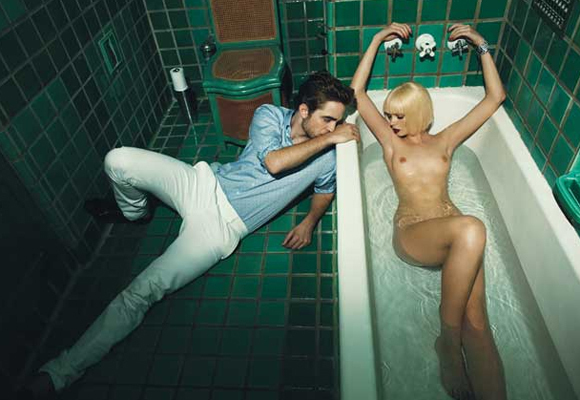
As a society, we come to expect the next shocking celebrity photoshoot. I'll use tween heart throb Robert Pattinson as an example.Warning: Nudity and Implicit Degredation A naked woman lies submissively spread eagle in a bathtub while the clothed and dominant male lies disinterestedly on the floor. These images don't sell a product, they sell a cultural standard. Barthes's model, for instance, we see Mr. Pattinson in the trendiest white slacks and relaxed button-down shirt, signifying modern success and masculinity. Enforcing the signifier, the naked woman solidifies the meaning of the ad--Mr. Pattinson in his smart slacks and sexy shirt has conquered the beautiful model, making the sign of fantasy masculine dominance concrete.
2.24.2010
Portraits, Assignment #2
This is the first image I chose, and the first image I successfully and extensively edited with photoshop. The original image was much brighter and contained many dots and reflections from the use of the flash. First, I used curves to darken midtones and shadows to create much more of a mysterious and creepy theme. I found the "clone stamp" tool extraordinarily useful and was able to clandestinely remove the brighter flash reflection on the CPR poster behind the dummies. I've always thought the lifeless disembodied torsos to be unsettling, and the edited image accentuates the anthropomorphic lifelessness.
This is a picture of my hand against the textured shade of the bus. Driving back from the UCF speech disorders clinic a few weeks ago, we found ourselves in gridlock traffic on Aloma ave. With few things other than my camera and my good friend Anna to entertain me, I proceeded to take a few snapshots of my surroundings. This was not originally one of my top picks--though after sitting and reviewing the initial photographs with Professor Roe, we examined the texture and subtle colors and came to the conclusion this picture was in fact impressive. I love how the shadows accentuate the tendons and knuckles in my hand and provide an interesting texture over the skin. I also edited this photograph, just barely darkening the exposure and adding a bit more reds and magentas to make my skin look a bit more vibrant. Overall, I'm extremely happy that I chose this image to print.
We chose this as the strongest portrait in the group. This is of my best friend, partner in crime, and fellow budding neuroscientist, Shakirra. The white negative space and the right-weighted black-clad profile makes this a very strong portrait. I barely edited this photograph just enough to lighten her hair. The button at the bottom and the chain accent the dark jacket and turtleneck shirt. The subtle curve of her hair on her right shoulder is lovely. It's obvious that this girl is beautiful, and I think this picture captures a little bit of that.
The story behind this photograph is great. We got up early one morning to meet and rehearse a neuropsychology presentation before class one day. She's just about as neurotic as I am, but since I was confident about the project we clashed a little bit about the practicing. I was certain this was superfluous preparation but nonetheless agreed to meet her. We found an abandoned classroom in the science/psychology building and went through the presentation flawlessly. She insisted on going through the presentation one more time, much to my chagrin. I decided to read my slides while spinning around in an office chair and then walking dizzily around the room. This didn't distract her enough so I took out my camera to take pictures of her while she was talking, attempting to unnerve her. After a few shots, I realized the background of the white projection board looked indistinguishable from a professional portrait background set. I took about forty images of Shakirra, many which turned out wonderfully. Professor Roe and I agreed this was the strongest, and this ended up being the number one image to satisfy my second assignment.
This is a picture of my hand against the textured shade of the bus. Driving back from the UCF speech disorders clinic a few weeks ago, we found ourselves in gridlock traffic on Aloma ave. With few things other than my camera and my good friend Anna to entertain me, I proceeded to take a few snapshots of my surroundings. This was not originally one of my top picks--though after sitting and reviewing the initial photographs with Professor Roe, we examined the texture and subtle colors and came to the conclusion this picture was in fact impressive. I love how the shadows accentuate the tendons and knuckles in my hand and provide an interesting texture over the skin. I also edited this photograph, just barely darkening the exposure and adding a bit more reds and magentas to make my skin look a bit more vibrant. Overall, I'm extremely happy that I chose this image to print.
The story behind this photograph is great. We got up early one morning to meet and rehearse a neuropsychology presentation before class one day. She's just about as neurotic as I am, but since I was confident about the project we clashed a little bit about the practicing. I was certain this was superfluous preparation but nonetheless agreed to meet her. We found an abandoned classroom in the science/psychology building and went through the presentation flawlessly. She insisted on going through the presentation one more time, much to my chagrin. I decided to read my slides while spinning around in an office chair and then walking dizzily around the room. This didn't distract her enough so I took out my camera to take pictures of her while she was talking, attempting to unnerve her. After a few shots, I realized the background of the white projection board looked indistinguishable from a professional portrait background set. I took about forty images of Shakirra, many which turned out wonderfully. Professor Roe and I agreed this was the strongest, and this ended up being the number one image to satisfy my second assignment.
2.09.2010
Classrooms and Clinicals
Wednesday, February 3rd represented my second appointment with K.J. Again, she was in good spirits, friendly, and engaging. Her language deficits are still apparent--she has trouble coming up with words (anomia) and many speech-motor difficulties. She has trouble with her R's, something for which I remember going through speech therapy in elementary school. Even when I was six and seven, I was profoundly embarrassed when I couldn't correctly roll my tongue and produce succinct "r" sounds. When attempting to say "prayer," K.J. vocalized a "play-uh" sound, representing a disconnect between Broca's area and the premotor and motor cortexes. She communicated well through hand signals and staccato sounds, and verbal hints help her with the anomia.
Caitlyn, our speech therapist student liaison, was wonderful enough to print us out a speech hint cheat-sheet with the possible hints that could help us give K.J. a little push in the right direction.
Phonemic hints give the first phoneme or sound of the word, possibly the first syllable as well. Semantic clues designate the category of the vocabulary objective, and gestural hints are simple affirmations of nodding or pointing to an available clue. Sentence completions are cloze-statements where K.J. can more easily finish a thought already in progress. Binary choices are simple either-or categories. We can provide written hints and also tactile clues by touching the table or paper. This taxonomic hierarchy allows us to categorize our arsenal of speech-therapy hints and learn the ways we can best help and communicate with our client.
K.J. is extremely quick-witted and responds well to any of the hints--but only if she can get the word quickly. I can empathize with her frustration--language is such a fundamental and overlooked part of daily life.
This is such an interesting learning environment, because our responsibilities as students go far beyond memorization and essays and tests to interpersonal relationship building and real-world skills academia sometimes loses sight of. In this service-learning class, we have the privilege of applying what we've learned--both on our own time and from the class itself--to a situation that makes that learning truly mean something. When learning incorporates real people, especially in a clinical or humanitarian environment, it transcends our conceptions of what school is and ought to be. Anecdotes become personal and we won't soon forget them.
For her "frame" assignment, we went through K.J.'s photos on the little screen on the back of the digital camera. We all talked about our favorites, and K.J. provided some wonderful stories about a random rooster walking down her neighborhood and a cat eyeing the intruder suspiciously. Some of her photographs were phenomenal, with a shadowy palm-tree providing sharp, spiky lines and impressive, stark contrast. We all agreed we liked a picture of a quaint and naturalistic lake with reeds and ducks, and K.J. became very excited. She said something about how it wasn't very pretty in real life. We weren't sure what she meant until she took Diego and I outside the UCF speech disorders clinic across the parking lot after class. She pointed to a glorified puddle, and we quickly realized that the retention pond happened to be the subject matter of her impressive photograph. We laughed how our professor would love that because it satisfied the assignment perfectly.
On the walk back from the pond, I asked her about her recovery since her stroke. For the past six or seven years, she's been in speech and physical therapy. She said it's helped a lot, that she was barely able to communicate in the weeks after the horrible event. She's been bored, but she recognizes the necessity. She said she loved the creativity that this photography class allows, and loves going to this appointment of therapy.
The service-learning environment goes far beyond instilling the student with memorable learning strategies and real-world experience. We're also helping the community, in this case our clients at the UCF speech disorders clinic. For an individual hoping to go into the medical field, I love the clinical aspect and learning about cues, strategies, and reading up on CVAs. In a traditional classroom, I wouldn't have much of an impetus to go so far out of my way to read articles and clinical strategies because I know I wouldn't need to implement those skills to get a decent grade in the class. I'm no longer just trying to impress my professor, K.J.'s comfort and happiness is a new and wonderful responsibility.
When we were closer to the clinic, K.J. began talking about the technical aspects about the camera. She pointed and remarked about the "22" megapixel count. She immediately noticed her mistake and tried to say twelve. She couldn't get the word out, so she began counting from one. These cues and patterns she's learned obviously greatly help her outside of the clinic, and it's awesome to have the privilege of being involved in her recovery.
Caitlyn, our speech therapist student liaison, was wonderful enough to print us out a speech hint cheat-sheet with the possible hints that could help us give K.J. a little push in the right direction.
Phonemic hints give the first phoneme or sound of the word, possibly the first syllable as well. Semantic clues designate the category of the vocabulary objective, and gestural hints are simple affirmations of nodding or pointing to an available clue. Sentence completions are cloze-statements where K.J. can more easily finish a thought already in progress. Binary choices are simple either-or categories. We can provide written hints and also tactile clues by touching the table or paper. This taxonomic hierarchy allows us to categorize our arsenal of speech-therapy hints and learn the ways we can best help and communicate with our client.
K.J. is extremely quick-witted and responds well to any of the hints--but only if she can get the word quickly. I can empathize with her frustration--language is such a fundamental and overlooked part of daily life.
This is such an interesting learning environment, because our responsibilities as students go far beyond memorization and essays and tests to interpersonal relationship building and real-world skills academia sometimes loses sight of. In this service-learning class, we have the privilege of applying what we've learned--both on our own time and from the class itself--to a situation that makes that learning truly mean something. When learning incorporates real people, especially in a clinical or humanitarian environment, it transcends our conceptions of what school is and ought to be. Anecdotes become personal and we won't soon forget them.
For her "frame" assignment, we went through K.J.'s photos on the little screen on the back of the digital camera. We all talked about our favorites, and K.J. provided some wonderful stories about a random rooster walking down her neighborhood and a cat eyeing the intruder suspiciously. Some of her photographs were phenomenal, with a shadowy palm-tree providing sharp, spiky lines and impressive, stark contrast. We all agreed we liked a picture of a quaint and naturalistic lake with reeds and ducks, and K.J. became very excited. She said something about how it wasn't very pretty in real life. We weren't sure what she meant until she took Diego and I outside the UCF speech disorders clinic across the parking lot after class. She pointed to a glorified puddle, and we quickly realized that the retention pond happened to be the subject matter of her impressive photograph. We laughed how our professor would love that because it satisfied the assignment perfectly.
On the walk back from the pond, I asked her about her recovery since her stroke. For the past six or seven years, she's been in speech and physical therapy. She said it's helped a lot, that she was barely able to communicate in the weeks after the horrible event. She's been bored, but she recognizes the necessity. She said she loved the creativity that this photography class allows, and loves going to this appointment of therapy.
The service-learning environment goes far beyond instilling the student with memorable learning strategies and real-world experience. We're also helping the community, in this case our clients at the UCF speech disorders clinic. For an individual hoping to go into the medical field, I love the clinical aspect and learning about cues, strategies, and reading up on CVAs. In a traditional classroom, I wouldn't have much of an impetus to go so far out of my way to read articles and clinical strategies because I know I wouldn't need to implement those skills to get a decent grade in the class. I'm no longer just trying to impress my professor, K.J.'s comfort and happiness is a new and wonderful responsibility.
When we were closer to the clinic, K.J. began talking about the technical aspects about the camera. She pointed and remarked about the "22" megapixel count. She immediately noticed her mistake and tried to say twelve. She couldn't get the word out, so she began counting from one. These cues and patterns she's learned obviously greatly help her outside of the clinic, and it's awesome to have the privilege of being involved in her recovery.
1.27.2010
Assignment #1: The Frame...and meeting K.J.!
In a slightly belated post, I will post the top three images I edited and produced with the point-and-shoot digital camera for the Photography as Language class.
This was the first time I attempted using photoshop, but after the prints and critique, I was very happy with the results.
These two images I chose plainly for their aesthetic value. The deep and bright greens and the overwhelming cyan-blue truly shined from the original images. After a brief tweaking of highlights and shadows then playing with color balance produced images that I am proud of.
This was the first time I attempted using photoshop, but after the prints and critique, I was very happy with the results.
These two images I chose plainly for their aesthetic value. The deep and bright greens and the overwhelming cyan-blue truly shined from the original images. After a brief tweaking of highlights and shadows then playing with color balance produced images that I am proud of.Of course, I decided not to show my patient these, instead, ever attempting to be the amateur neuropsychologist, provided this picture of my girlfriend on the beach. I told her "go run at those birds so I can take a picture!" to which she happily obliged. I felt the image provided a story and a plethora of descriptive words to review for an aphasic patient. Sand, clouds/cloudy, birds, flight/flying, running, beach, smile/smiling, and various nouns, verbs, and adverbs. I had just read a paper for neuropsychology outlining the double disassociation of noun/verb duality. Patients often have trouble with either words related to imagery or trouble with more nebulous concepts. It's easier to imagine a bird in your head, but the imagery of "flying" requires one to create a mental scenario with an object to partake in flight.
Of course, I got what was coming for me. My client, K.J., is extremely feisty, extraordinarily smart and quick-witted. Well, she took one look at my picture, frowned, and pointed to Diego's photograph of beautifully composed and vibrant marker heads, creating a rainbow pattern of random colors. K.J. used to be a painter before her stroke, and of course was attracted to the superior and more interesting image.
This is a great lesson in the attempt of a scientific intent and the subsequent realization of its absolute absurdity. I just might have to rethink this whole case-study idea...K.J. is much too entertaining, engaging, and hilarious to drone on about dry clinical facts. Oh, but I'm not abandoning that aspect totally. Something I noticed quite early on was K.J.'s immediate verbalization of what I'll call "frustration words." The first words I heard her speak were a "What the hell?!" pointing to her speech therapy scheduling, jotted confusingly on a sticky note.
She presents with anomia, telegraphic speech, and other non-fluent presentations. Right-side hemipelegia is apparent as she lost the majority of fine motor control of her right hand, which must be extraordinarily frustrating to a former painter. She is acutely aware of her language deficits, and quickly inserts a frustrated "crap!!" in place of an unknown word. We took her outside to show her how to use the camera, and joked about the dismal scenery outside of the building. "What do I do!?"gesturing with her camera, "picture of dead bush?!"
1.26.2010
Pre-Patient Preconceptions
For the past week, I've been extremely excited about meeting my client, known to me at this point as K.G. (And due to HIPA, she will henceforth be referred to by her initials on this blog.) I'm paired up with a speech pathology graduate student, Kaitlin, in her third year of the Masters program at the Communicative Disorders program at the University of Central Florida. Speech therapists perform a variety of roles ranging to clinical rehabilitation after injury to helping children develop stronger speech patterns to even training actors how to perfect accents.
At this point, I have only a brief clinical presentation with a few behavioral anecdotes. K.G. is currently in her early fifties and suffered a stroke in 2003. She is extraordinarily independent, and cohabitants with and cares for her blind father in his mid-eighties. K.G. was, and is, an extraordinarily intelligent woman, a member of Mensa (meaning she scored above the 98th percentile on a standardized IQ test) and fiercely self-determining. Coronary and cerebral artery disease caused a piece of atherosclerotic plaque to dislodge from her carotid artery, common etiology for an ischemic stroke. Her stroke six years ago left major non-fluent language deficits (Broca's), minor cognitive reasoning difficulties, and minor right-side hemipelegia, all consistent with left anterior frontal cortex damage. She is able to communicate with labored telegraphic speech and successfully utilizes verb networking and external clue sheets to facilitate communication. Due to her intelligence, apparently largely intact, she becomes extremely frustrated at her inability to succeed at simple tasks. Until I have HIPA clearance and get ahold of the medical records, this is the furthest I can speculate on the clinical presentation.
This is an MRI of an individual that has suffered an ischemic stroke presenting with Broca's aphasia. Each stroke and each patient's neuroanatomy varies, but Broca's and Wernicke's areas of the brain are correlated strongest with language production/motor control and logistics/comprehension, respectively. Broca's aphasia, known as "non-fluent" aphasia, creates labored speech production or an inability to produce speech. Comprehension is usually intact, adding to the frustrating nature of the condition. Telegraphic speech, usually one or two words denoting the gist of the thought, tends to be the average level of communication most Broca's patients can muster. Hemiplegia, or one sided-paralysis, is common because Broca's area is so close to the pre- and primary motor cortex.
Broca's is the most common aphasia, with over 70% of aphasic patients falling under major non-fluent categories. This is because of the complicated vascularization pattern of the brain--Broca's area happens to lie adjacent to a major cerebral artery branching off the carotid artery in the neck. The carotid, like many arteries surrounding the heart, becomes covered in sticky plaque that can attract blood clots. High blood pressure usually causes one of these clots to break off from the diseased artery and cause ischemic damage to the two most vulnerable tissues--the heart and brain.
Science tends to be impersonal, detached, and uncaring. I reject this outright, and it's one of the reasons I love the field of neuropsychology so much. Case-studies, detailed and personal accounts of patients, have little choice but to include emotional developments between a clinician and patient. While I understand the need for double-blind pharmacologic studies, assessing individual therapies on a patient-to-patient basis gives neuropsychology an entirely different aesthetic from other descriptive sciences. I'm looking forward to interacting with K.G. and participating in her therapy. Six years after her stroke, it's highly unlikely that she will regain any major language or motor functions lost from the stroke, but the brain is phenomenally malleable. I know she is an incredibly intellugent person, and her drive in relation to these specific photographic therapies, I can safely assume, will literally rewire parts of her brain. I will be recording as many observations I can throughout this process with the hopes of writing a case-study, but I won't let that devalue the patient herself. This is an amazing opportunity not only for an amateur neuropsychologist, but hopefully for KG as well.
Subscribe to:
Comments (Atom)